This is my final blog about Churchill Island, and I've chosen the Norfolk Island pine for lucky last -- because it's so special.
From a distance, Churchill Island appears as a small bump on the horizon, but it's a bump with a differences. Midway along the bump something tall extends skywards -- a 38 metre tall Norfolk Island pine.
Planted in 1872 by Samuel Amess -- and propagated by his friend Ferdinand Von Mueller at the Royal Botanic Gardens -- the tree is still growing strongly.
Its trunk is broad and invites you to touch, to stroke; to feel the strength flowing up from roots thrust deep into rich volcanic soil. Perhaps the roots have tapped into an underground water supply, but even if they haven't, rainfall on the island is regular and plentiful.
Samuel Amess planted the Norfolk Island pine on the highest point of the island, alongside his newly built home. Now, in the year 2012, it's a grand tree able to be seen from all around Western Port Bay. It's a definite landmark.
Running my fingers over the bark I felt its rough texture, heard a breeze playing in the topmost branches, smelt the distinctive aroma of pine. I continued to stroke, letting my mind drift, dream ----.


 Amess House is typical of the resort homes built in the Western Port Bay region in the 1870s, and contrasts greatly with those built at the present time.
Samuel and Janet Amess lived in Melbourne and holidayed on Churchill Island for 60 years. Amess came from Scotland and made his fortune in the gold fields of Victoria. He went on to be a notable builder, stonemason, bridge builder and the Mayor of Melbourne.
Samuel Amess purchased Churchill Island as a place where "he could loosen his tie and enjoy the tranquillity with his family". The home he built (which stands today and is shown in the photographs) is of Italianate style and was fashionable at that time. Cast iron lacework decorates the outside, while inside there's a dining room, morning room, master bedroom, drawing room, kitchen with colonial oven, scullery, nursery, children's bedroom, store room, cellar (a cool place where there was a Coolgardie safe, butter churn and cheese press) -- and a barn.
In the year 2012, travel between Melbourne and Churchill Island takes about two hours, by road, with most of the journey being on a freeway. Two bridges solve the problem of Western Port Bay.
In the 1870s the journey was not so easy. A Cobb & Co. coach carried the Amess family from Melbourne to Mornington, where they boarded a boat to Hastings, and then crossed Western Port Bay to Churchill Island. There were no bridges or freeways in those days.
In the 1870s, a manager ran the property and servants looked after the family while they were living on the island. The servants lived in cottages separate to the main home.
When Amess House was being restored, original wallpaper fragments were discovered and reproduced to help restore the house to its original state. The restoration process was carried out by experts and a dedicated team of volunteers, so the result is pleasing and a true representation of this past era.
Tomorrow I'll show you the charming garden that surrounds Amess House.


 Ever since the first man decided to settle in one place, and farm an area of land, he's needed a shed -- somewhere away from his wife and family where he could hammer and saw; measure and construct; have time out to think and dream. The men who farmed Churchill Island were no different. All of them needed a shed in which to do all manner of manly things.
Lieutenant James Grant -- in 1801 -- recognised the rich fertility of the soil and the sheltered position of Churchill Island. Consequently, he planted seeds for Victoria's first vegetable garden, and also planted the first crop of wheat. In addition, he planted corn, oats, barley, onions and potatoes.
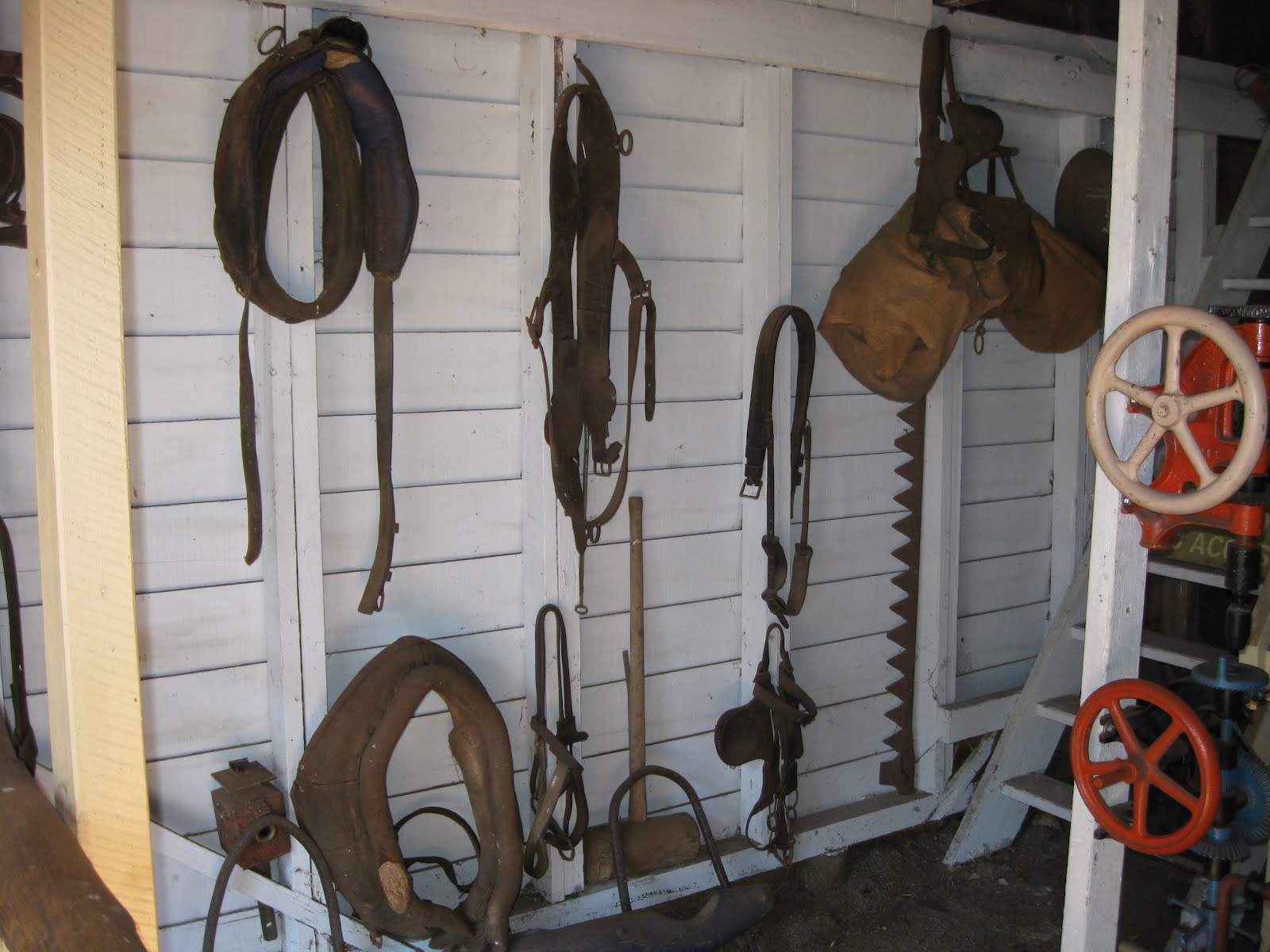
Original farm sheds on the island have been restored and now contain vintage farm machinery such as ploughs, water carts, horse-drawn hedge cutters - - -.
A flock of Suffolk sheep provide sheep for demonstration shearing, as well as sheep for the working dogs to show their herding abilities. It was Ranger Scott Campbell who, with his Jack Russell terrier 'Jack' and a team of ferrets, finally rid the island of introduced rabbits.
Churchill Island shows how a farm environment can coexist with the natural environment, without damage, and without demanding too much from the land itelf.


 Churchill Island offers visitors a taste of farming practices as they were in "the olden days". Every day there's a demonstration of hand sheep shearing, whip cracking and boomerang throwing, Border collie dogs working sheep and ducks, a blacksmith demonstration, wagon rides, and the hand milking of a Jersey cow called Tabitha. The milking is popular with children who think of milk in cartons in supermarkets and are amazed to see it coming from a cow.
Our first farm was only 13 acres, but it was here in Western Victoria that we learned to take care of sheep, cattle, goats and poultry; build fences -- -- -- --. It was a steep learning curve, as both of us were brought up in the city of Melbourne.
One morning, when I'd walked to the gate to collect the mail, I heard a faint noise in the long grass and upon investigation found a one day old Jersey calf. She had such badly grazed front knees that she couldn't stand, but when her enormous eyes met mine it was love at first sight.
Doug and I carried her back to the house where we came to the conclusion that she'd probably fallen off the back of a truck or trailer on the way to the weekly calf market in Colac.
Weeks of loving care followed as we bathed and dressed her knees, waited for the swelling to reduce, and then helped her learn to walk again.
We kept her for 15 months before selling her to our neighbour who milked a small herd of cows. But I was in tears when she finally left our care.
PS
It seems strange that most Jersey cows have gentle, reliable temperaments, whereas Jersey bulls are renowned for their bad temper and can rarely be trusted.


 Clydesdales have been part of Churchill Island since settlement, in the 1800s. Their docile temperament, impressive size, large shock absorbing feet, and silky flowing feathers all add up to make one of the finest of all domestic animals.
Over the years, Clydesdales have been used to plough the rich volcanic earth of Churchill Island, help with the harvest, and in 1936, build a dam, which is still in use today. They are, and always have been, part of Churchill Island's charm.
Today they give visitors wagon rides, and are also used to work the farm.
Although we've never used horses in our farming career, I love the idea of Clydesdales, but only when they are looked after properly and not worked too hard. They remind me of James Herriot books and films, of a past era when people could make a good honest living milking 20 or so cows, and planting a crop or two using Clydesdales to help plough and harvest.
I don't like the trend towards huge herds of cows and factory farms where the quality of life for the animals has deteriorated. Domesticated farm animals deserve much better than this.
PS
A Clydesdale, carved from wood using a chainsaw, is another attraction on the island.