Wednesday, March 7, 2012

Out on the town!


A shopping day in Wonthaggi and Leongatha (mainland, Gippsland) provided almost everything we needed to equip our 'new' second-hand caravan. The colours I chose were blues and fawns. Although I'm pleased with our purchases I feel a bit uneasy about the fact that almost all of the 'stuff' we bought comes from China.

While off the island, we also took the opportunity to have our eyes tested, with good results.

Driving back over the bridge and on to the island is always a good feel. Home at dusk, just like the mutton birds. Us to our home alongside the rookery; the mutton birds, home to their burrow where a hungry chick awaits their parents' return.

Perched on a chair on our front verandah, I found a bunch of beautiful flowers, a gift from our very thoughtful friend. Janet. I'm sure you'll agree, there's something very special about a gift of flowers.

Tuesday, March 6, 2012

Athol's genius with 1940 Plymouth


A phone call last night from Athol in Mitchell told Doug excellent news.

In early February this year, the Maranoa River flooded Doug's 1940 Plymouth sedan to a level over the steering wheel. Subsequently, Athol offered to care for and tinker with the old girl.

In the process, he drained the engine of two buckets of water and oil. Then he flushed the engine with diesel, cleaned out the carburettor and distributor, fixed the starter motor, charged the battery, and drained the gearbox and diff.

"The old girl is going!" declared Athol on the phone last night, "better than ever!"

Doug's not surprised, as he knows better than me of Athol's remarkable mechanical skills. Nevertheless Doug's very happy! And so too am I.

Monday, March 5, 2012

Seahorses and Seadragons: Aphrodisiacs and Medicines


The dried remains of seahorses and seadragons are sometimes washed ashore, bleached by sun and salt, yet still exquisite in their beauty and charm. It is the hard outer case that resists decay and that's found in tangled flotsam.

Big-belly seahorses, weedy seadragons and spiny pipehorses are all closely related, and are fishes -- stunningly coloured and patterned.

Dried specimens are used in traditional medicines and aphrodisiacs -- in Asia. Live specimens are sought after for aquarium fish, and by collectors.

Weedy sea dragons have leaf-like appendages, a camouflage evolved to mimic small patches of kelp or the sea grass meadows in which they live. Exquisitely ornate and charming, I cannot help but pause and marvel at their unusual beauty.

PS
The photos with a blue background show specimens we found here on Phillip Island.

The other photo shows specimens sourced from a seahorse 'farm' located in Tasmania. This 'farm' sells seahorses for the aquarium trade, and to Asia. Their aim is to prevent seahorses being taken from oceans and bays, where they are becoming endangered.

Sunday, March 4, 2012

Big Bad Banksia Men: created by May Gibbs


Following on from yesterday's blog about banksias, I'd like to show you some of the ways in which people have made use of the flowers and cones.

Early in the morning (before nectar-loving birds and evaporation took their share) Aboriginal people sucked the sweet beads of nectar from large banksia flower spikes. Alternatively, they soaked the blossoms in water to make a sugary drink, sometimes allowing natural fermentation to take place.

When squeezing the individual flowers, a sticky sugary secretion transfers to your fingers. Bees, beetles and honey-eaters also enjoy sipping the nectar from banksias.

Banksia timber has magnificent colour and grain and therefore makes excellent furniture. The cones are used in wood turning. In the photos, you can see the egg turned from a banksia cone -- and close-ups showing the colour and grain.

Aboriginal people had an entirely different use of banksia cones. Smouldering cones were used as torches and for warmth.

Botanical artist Celia Rosser has made it her ambition to paint (using watercolour paint), life-size and in the finest detail, all species of banksia. Examples of her work are shown in the photos: one on the front cover of the book, the other on page 20. Her work is an inspiration.

Australian children's author May Gibbs (1876 to 1969) wrote of Big Bad Banksia Men, and worked crooked eyes and mouths into drawings of a banksia cone. Her books Snugglepot and Cuddlepie are Australian classics and have been recently republished.

Saturday, March 3, 2012

Stunning gnarled trunks and banksia cones


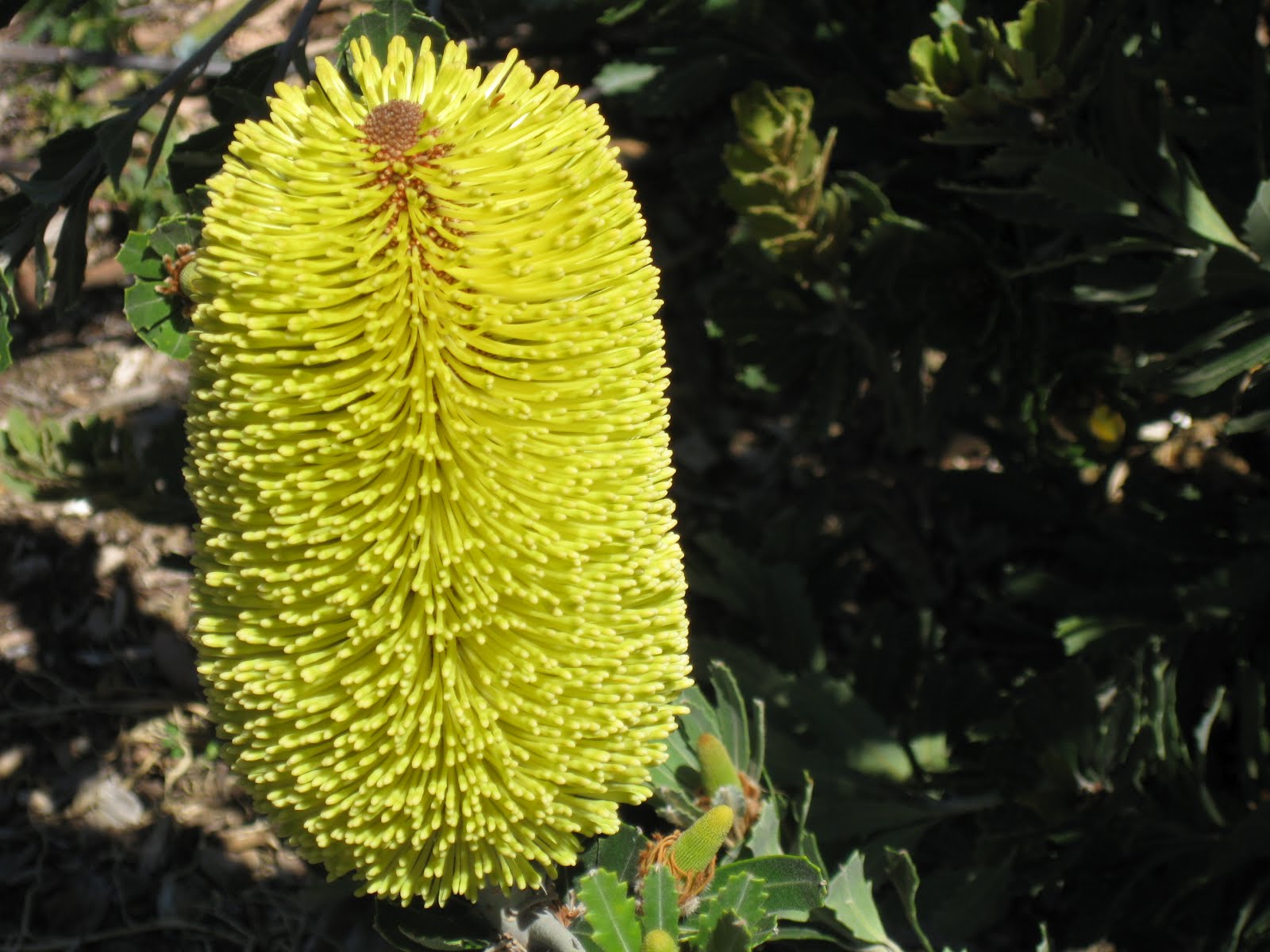
Australia's 78 species of banksia give vibrancy and rugged texture to our vegetation. Named after Sir Joseph Banks (the 'father' of Australian botany), banksias were first observed by him in 1770, at Botany Bay.

Sometimes described as bottle brushes, honeysuckles or candlesticks, the flowers and cones are highly sought after for floral arrangements -- worldwide.

Each large showy flower is actually a dense cluster of up to several thousand individual blooms. The flower spike develops into a woody cone -- after flowering -- with each of the tightly closed woody capsules containing one or two winged seeds. The seeds are usually released after a bushfire.

Coastal banksias (Banksia integrifolia) grow to about 25 m, have narrow leaves that are silver underneath, and have pale yellow flower spikes. They are popular with nectar-loving birds and seed-eating parrots.

Old trees develop stunning gnarled trunks with rough speckled bark, often adorned with orange lichens. They make a dramatic statement in coastal vegetation on Phillip Island.

PS
Tomorrow I'll show you some of the uses made of banksia flowers and cones, and also how they've been used in children's literature.

Friday, March 2, 2012

Sponges are living animals


Although I'm not able to walk along the beach at present, (because I'm still recovering from a hernia operation), every day Doug brings home treasures from the sea.

Today's treasure was a collection of sponges. As sponges are attached to rocks, look simple in structure and are colourful, many people mistake them for plants. In fact, sponges are animals made up of masses of living tissue supported on a simple skeleton. When you look at a sponge you can see thousands of tiny holes (pores) through which the sponge passes water, filtering out microscopic food particles.

Sponges do not have organs such as a stomach, liver and nerves. They are one of the simplest form of animals on Earth.

When beach combing along the shore, the skeletons of sponges are often found tangled up in flotsam. Most have lost their living colours and are a dull brown or bleached white colour, but they generally retain the shape they had when alive.

The shape of sponges varies widely and makes them interesting to collect. They range in form from fans, to cups, to tubes, to saucers. Some come with interesting common names such as dead man's fingers, hand sponges, terrace sponges, double fans, holy sponges and saucer sponges.

To the touch, sponges are soft.

Sponges do not grow in isolation; they are just one part of the rich ecology of the ocean. Their unusual shapes and bright colours, however, make them an attractive part of the marine scene.

PS
Doug took this photo of me having an afternoon rest with my 15-year-old Siamese cat, Katie. She's the most delightful and affectionate animal friend I've ever had -- I love her dearly!

Thursday, March 1, 2012

Water in right and wrong places


With the recent Mitchell floods still so vivid in my mind, my heart goes out to all those people in northern Victoria and New South Wales who are -- at this point in time -- suffering floods. There seems no end to abnormal rain events throughout Australia, which brings to mind climate change and our need to prepare ourselves for more severe storms and torrential rains. But it's not easy. It's extraordinarily difficult!

On the other hand, oceans and bays hold water that's in its correct place. Western Port Bay -- which laps the northern shores of Phillip Island -- holds a wealth of plant and animal life.

In 2003, about 30 paper nautilus shells washed up onto the sand after a very high tide. These delicate creamy white shells are the egg case of a female octopus. Last year we found just one, and it sits in pride of place on our dining room table. Other treasures include shells exquisite in their shape, size and colours, sea urchins, a shark's tooth, and a piece of driftwood weathered by salt, sun and sea.

But a nautilus shell is the ultimate treasure.